
RESoArmor is ultimate in drum finishing technology! More durable and beautiful than conventional wrap, and without the loss of resonance. It’s really the perfect material for gigging drummers, who value tone and resonance from their drums. Even cooler, every finish is hand applied, and one-of-a-kind. Nearly any color combination is possible- just contact us with your ideas, and we will make them a reality!
Introducing our new BR3 Suspension brackets!
The INDe BR3 allows drill-free accessory suspension mounting on nearly any drum!
The BR3 is the newest addition to the lineup of INDe BR series tom & accessory suspension mounting brackets. This new, patent pending design replaces any lug on nearly any drum, using the existing mounting holes. It allows drummers to mount toms, convert mounted toms to floor toms, or add accessories to any drum, without drilling additional holes. The unique spring-steel construction helps isolate the base from the clamp, allowing accessories to resonate freely, without restricting the sound of the drum.
Specifications
Adjusts to fit lug hole spacings from 1-2"
The clamp adjusts to fit mounting 9.5, 10.5, and 12.7mm mounting posts
Brass tension rod receiver for smooth tuning
Low profile (<2" tall) and low mass (265g)
Includes Memory Lock
Patent Pending
Trey Gray checking out our Stainless Snares
If you haven’t figured it out already, INDe is all about thin shells and lightweight hardware, which is the key to versatile drums that don’t choke at any tuning. Trey Gray (drummer for Brooks & Dunn, Reba, Faith Hill, Jewel, and more) stopped by Independent Drum Lab HQ to pick up his new kit, and ended up snagging 2 of our Stainless Steel snares. Here is how it went down!
Tuning Video #2, Tuning Toms
This video explains how to apply the 2-key drum tuning technique on toms. This will help you tune your drums faster and more evenly than ever before!
Tuning Video #1, Tuning Theory

Drum Shell Design 101. Why our shells kick ass.
The easy way to market a drum design is to focus on the wood species, number of plies, and bearing edge angles- all of these are the wrong details to consider.
Read MoreDrum Showroom podcast
A couple of weeks ago, I was interviewed by Dan Radin on his new Drum Showroom Podcast. It is pretty much a total drum sound nerd-a-thon, so tape up your glasses, and load up your pocket protector, and have a listen! https://drumshowroom.wordpress.com/2017/11/01/ep7/

Our goal at INDe drums is to serve drummers better, and our videos are built to serve that philosophy. The purpose of our demo videos is to give a clear representation of what the drums ACTUALLY sound like, and will sound like when you get them home.
We could follow along with the drum industry norms, and go to a fancy studio, close mic everything, add some compression, some gain, some reverb, EQ out the harmonics, gate out the snare buzz, and make them sound pretty much like every recorded drum sound you have ever heard. Maybe some slick lighting, bring in some famous drummers to play them- you know the drill- we have seen it all before. The problem is, we could take our drums, some competitor's drums, and some beat up Craigslist beginner kit, and get them to sound about exactly the same- it doesn't really give any indication of how the drums really perform.
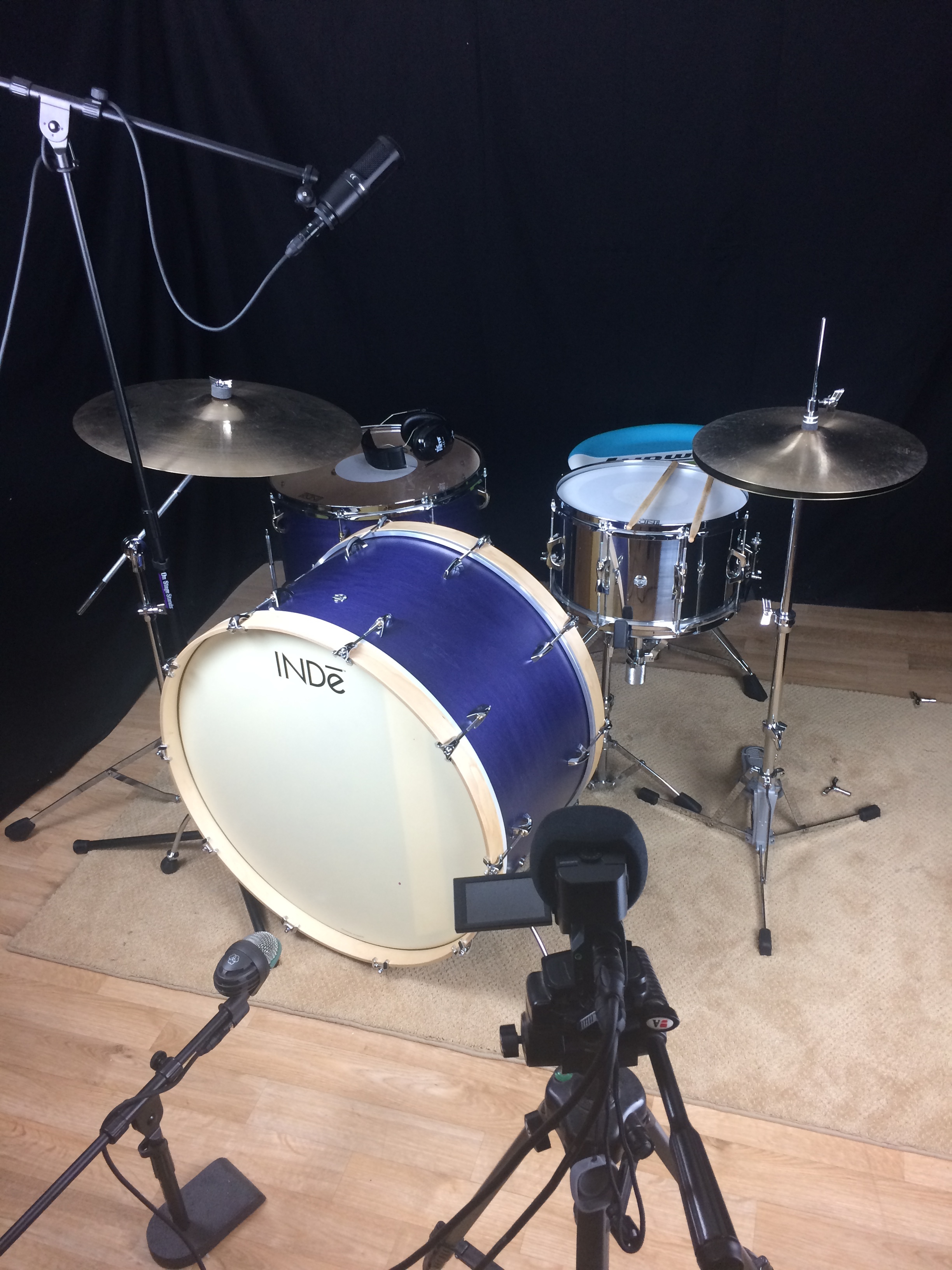
The photo above shows our setup for some recent snare demos- Zoom Q8 camera, an AT2020 overhead mic, and a D112 on the bass drum- all far away from the drums, to give the most realistic impression of what the drums sound like in that room, and in person. You don't listen to drums with your ear right up against the head, and for demoing a drum, that isn't where the mic's should be either.
I don't have a mixer, or any way to add compression, or any other studio magic. We keep it simple, real, and accurate. Our videos show what the drums sound like, and you should expect nothing less.
Why our demos are Lo-Fi, and why you should expect nothing less!
Snare Drum Demos!
Finally put together some snare drum demos for our current lineup. All drums are equipped with Aquarian Texture Coated batter heads, Classic Clear Snare resonant heads, 20 Strand Bronze wires, and Steel 2.3mm Triple flanged hoops.
As always, recorded with no Studio Tricks, No EQ, no close mics. We used a Zoom Q8, AT2020 overhead, and a D112 on the bass drum. Just an honest representation of what they sound like. Put on some nice headphones and enjoy! (please forgive my playing!)
5.5x15 Maple
6.5x14 Maple
5x14 Maple
6.5x14 Black Nickel over Brass
5x14 Black Nickel over Brass
6.5x14 Aluminum
5x14 Aluminum
I like big drums and I can not lie.
Demo of a 14x26, 9x13, 16x16, 16x18 kit with a 5.5x15 snare drum. These things sound huge, and I am falling in love with the 15" snare. Filmed with a Zoom Q8, and a D112 and AT2020.
About the Suspension Brackets
In addition to making INDe drums sound great and resonate like nothing else, our Suspension Brackets are available to upgrade your drums! With slotted mounting points, they can adjust to fit any hole spacing between 30 and 50mm (up to 2"). The patent pending design allows you to tune the mount to find the sweet spot of resonance on your drum.
Ignore the choppy editing and check out this video to find out more:
These will make your drum sound better! Available here:
Mass (not -achusetts)
There are a million different ideas and opinions circulating the internet and drummers heads about how to make drums sound good. Honestly, you can take any reasonably well constructed drum, and with good heads and tuning, you can make it sound pretty good. Because you are reading this, I will assume "pretty good" isn't good enough for you, and you are ready to dive head first into a bit of drum nerdery with me.
This outlines the path of vibrational energy through the drum:
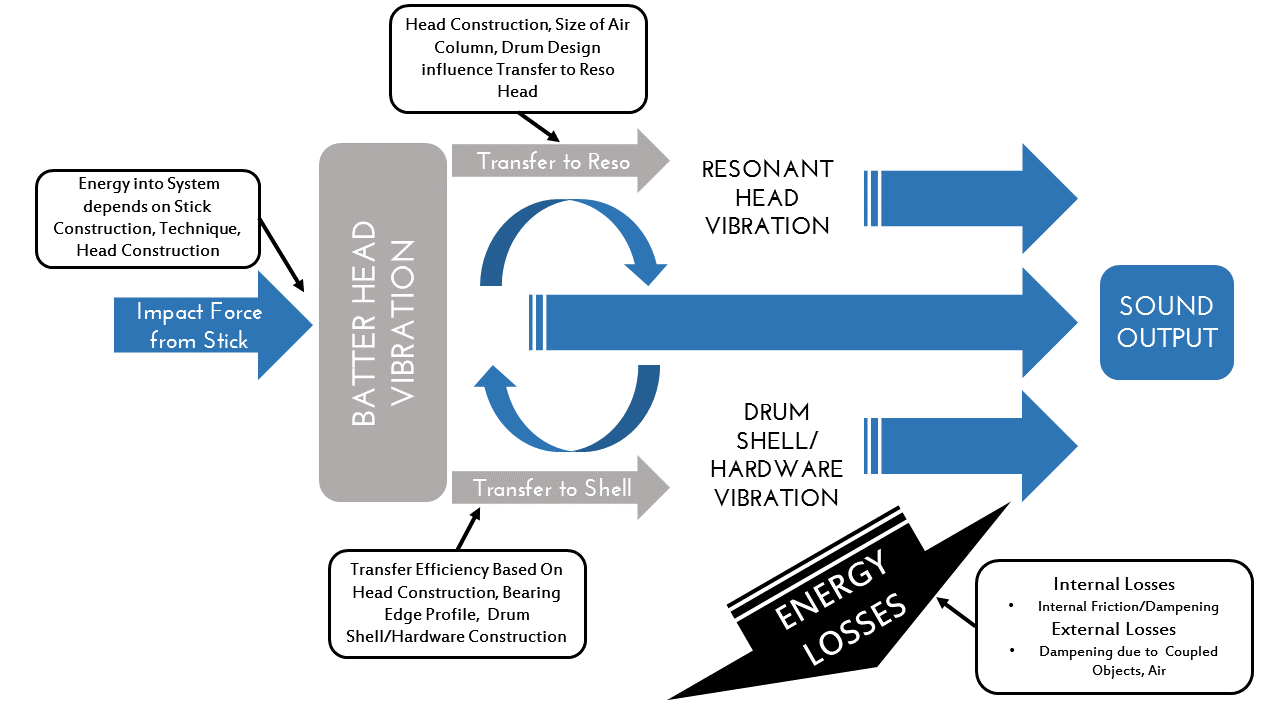
At it's most basic, vibrational energy is created by striking a drumhead, transferred around the various parts of the drum. Some of that energy is lost (converted to a small amount of heat), and the rest comes out as sound. A couple of important notes:
- More mass requires more energy to vibrate. Less mass = greater sensitivity
- Materials that vibrate less efficiently (wrap/rubber gaskets, etc.) increase energy losses
- The energy transfer from head to shell and back is controlled with bearing edge design- more contact = greater energy transfer.
This video demonstrates some of these effects: